How AI Chatbots Solve Issues in Real Time

AI chatbots have transformed customer service by offering instant responses, handling high volumes of inquiries, and reducing costs. Here’s why businesses are turning to AI for support:
- Speed: AI chatbots respond in under a second, compared to 45 seconds for human agents.
- Efficiency: They resolve up to 80% of routine queries without human help.
- Scalability: Manage thousands of conversations simultaneously, even during peak times.
- Customer Preference: 82% of consumers prefer chatbots over waiting for a human.
- Cost Savings: Businesses save up to 95% per interaction by using AI.
These tools also integrate with customer data to provide personalized answers, predict needs, and improve satisfaction scores. Companies like Bank of America and Emma App have seen faster resolutions, higher satisfaction rates, and significant cost reductions. AI chatbots work best when paired with human agents for complex issues, ensuring smooth escalations and better outcomes.
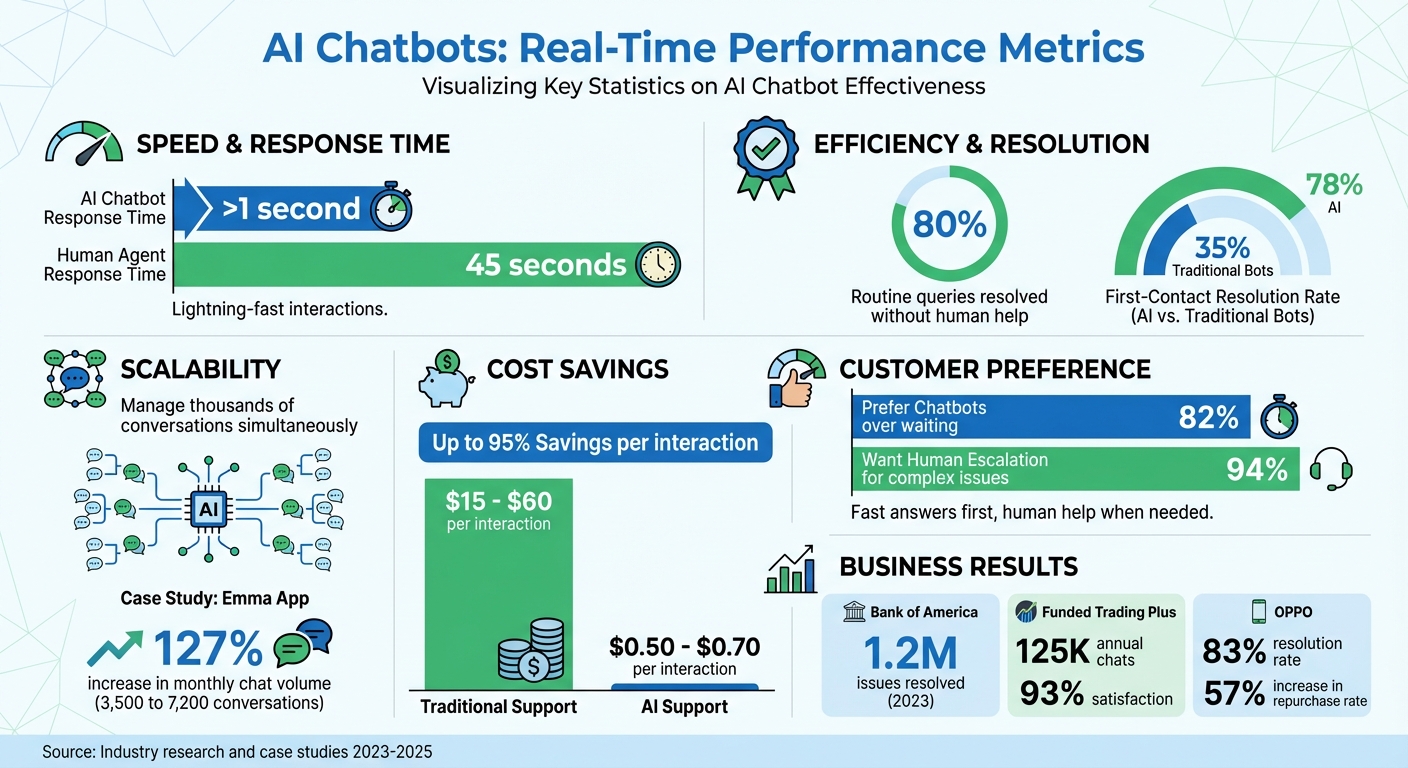
AI Chatbot Performance Statistics: Speed, Efficiency, and Cost Savings
Beyond Just Chatbots: How to Use AI in Customer Service the Right Way | ClickUp
sbb-itb-3988b8d
How AI Chatbots Understand Customer Questions
For a chatbot to do its job well, it needs to truly understand what customers are asking. AI chatbots rely on advanced language analysis to figure out the meaning, context, and intent behind customer questions.
Natural Language Processing (NLP)
Natural Language Processing (NLP) is the technology that helps AI interpret human language as it’s naturally spoken or typed. When a customer sends a message, the system processes it by normalizing the text, breaking it into smaller parts (tokenization), and analyzing how the words relate to one another.
Customers often use slang, make typos, or phrase things differently, and that’s where NLP shines. For example, it can recognize that "Where's my stuff?", "Track my package", and "I need to know when my order arrives" all mean the same thing. This capability significantly boosts performance - NLP-powered chatbots see 35–40% higher customer engagement compared to older, rule-based systems. They also achieve first-contact resolution rates of 78%, which is more than double the 35% rate seen with traditional bots.
"Modern AI chatbots understand context and engage in natural conversation - no longer glorified search engines." - Bill Cava, Chief Product Officer, CustomGPT
Intent Recognition and Context Awareness
Intent recognition allows AI to figure out what the customer wants to achieve. Instead of looking for exact word matches, the system identifies whether the customer is trying to track an order, request a refund, or update account settings - even if the wording varies significantly. These systems boast impressive accuracy rates of 85–95%, with top-performing commercial models reaching 90% or more.
Context awareness takes this a step further by letting the chatbot "remember" details from earlier in the conversation. For instance, if a customer asks about a laptop and then follows up with, "How much does it cost?", the AI knows "it" refers to the laptop. This eliminates the need for customers to repeat themselves and enables smooth, multi-turn conversations that feel more natural. A great example is Vagaro, which adopted Zendesk AI in 2025. By using intent and context-aware automation, they achieved a 44% auto-resolution rate, cut resolution times by 87%, and earned a 92% customer satisfaction score.
These advanced capabilities allow chatbots to deliver fast, tailored responses, making interactions feel seamless and efficient.
Instant Responses and Scalability
Speed and Efficiency in Customer Service
Speed is everything when it comes to customer service. A recent study found that 82% of users turn to chatbots specifically to avoid long wait times, and today’s AI chatbots respond in under a second. As AgentiveAIQ puts it, "The standard chatbot response time in 2024 is under 1 second - real-time is table stakes."
But speed isn’t the whole story. Customers also want quick resolutions - 47% expect their issue to be resolved during the very first interaction. To meet this expectation, advanced AI systems use Retrieval-Augmented Generation (RAG), pulling accurate answers directly from verified company resources like FAQs, documentation, and manuals. By adding fact-checking layers, these systems reduce errors by 70% while maintaining fast response times. This approach enables AI to resolve up to 80% of routine customer queries without needing human intervention.
A great example of this is fintech company Emma App. Between 2023 and 2024, they trained an AI chatbot using their FAQ and payment dispute workflows. The result? Their Head of Operations, Geoffrey Safar, reported a threefold improvement in resolution speed and full automation of weekend customer interactions. Despite having a small team of just five people, they handled a 127% increase in monthly chat volume - growing from 3,500 to 7,200 conversations - without hiring additional staff. This blend of speed and precision doesn’t just resolve issues faster; it also ensures systems are ready to handle growing demand.
Handling High Volumes of Conversations
AI chatbots don’t just respond quickly - they’re also built to manage massive conversation volumes simultaneously. While human agents can only handle one customer at a time, chatbots can juggle thousands of interactions at once without breaking a sweat. This ability makes them invaluable for businesses facing surges during product launches, Black Friday sales, or other high-traffic events.
Take Funded Trading Plus as an example. Using AI-powered automation, they manage 125,000 customer chats annually. According to Chief Strategy Officer Jamie Miller, this setup not only reduced the workload for their support team by 18% but also maintained a 93% customer satisfaction rate. Similarly, Bank of America’s AI assistant, Erica, resolved 1.2 million customer issues in 2023 through real-time, automated interactions.
The infrastructure behind these systems is designed for heavy lifting. Even when processing millions of messages from thousands of users at the same time, they maintain sub-second response times. Some enterprise platforms handle over 10 million messages each month, operating 24/7 year-round. This eliminates the dreaded "Monday overload" caused by weekend backlogs, which often overwhelm human teams. With this level of scalability, businesses can confidently rely on AI to deliver real-time solutions, no matter the demand.
Personalized Customer Experiences
Integration with Customer Data
AI chatbots are changing the game when it comes to personalized service by tapping into business systems like CRMs, order management tools, and inventory databases. Instead of sticking to generic scripts, these chatbots use real-time data to provide precise answers. For instance, when a customer asks, "Where's my order?" the chatbot can instantly pull up tracking details, delivery timelines, and carrier information to provide an accurate response.
This integration doesn't just improve accuracy - it makes interactions feel tailored. Take Sephora's "Virtual Artist" chatbot, introduced in 2016. It collected customer preferences to suggest personalized product recommendations and even offered virtual try-ons. By 2022, this tool had significantly boosted their e-commerce sales. Similarly, Maruti Suzuki teamed up with DaveAI to launch a WhatsApp chatbot powered by Natural Language Processing. This chatbot delivered customized responses, complete with images and documents, engaging over 400,000 users and handling 2.7 million queries. It even facilitated more than 10,000 test drive requests.
The impact of personalization is clear: 80% of consumers are more likely to buy from brands that offer tailored experiences. Personalized support also drives loyalty, with customers being 3 times more likely to recommend a company and having a 20% higher lifetime value. With Retrieval-Augmented Generation (RAG) technology, chatbots can verify pricing and product details on the spot, ensuring accuracy while keeping the interaction personal. Beyond just answering questions, these integrations allow chatbots to anticipate what customers might need next.
Predictive Engagement and Recommendations
AI chatbots don’t just wait for questions - they predict customer needs and proactively engage.
By analyzing browsing habits, purchase history, and interaction data, modern chatbots can step in at just the right moment. For instance, if a customer spends too much time on a checkout page or revisits the same product multiple times, the chatbot can jump in to help. It might suggest complementary items, offer a discount to encourage checkout, or answer questions to prevent cart abandonment.
A great example is OPPO, which implemented an AI chatbot integrated with Sobot's ticketing system to handle heavy customer inquiries during peak seasons. The results? An 83% resolution rate, 94% positive feedback, and a 57% increase in customer repurchase rates. This kind of predictive capability not only improves customer satisfaction but also boosts revenue. Companies using database-integrated AI chatbots have reported returns on investment ranging from 148% to 200%. These AI systems are also incredibly efficient, resolving 90% of queries in fewer than 11 messages.
Tools like Chat Whisperer make it easier for businesses to create these personalized experiences. By integrating AI assistants with CRMs and other business tools, companies can train chatbots using their own product catalogs, policies, and customer data. Features like data loaders for PDFs, Word documents, and websites ensure that every interaction feels custom-made rather than pulled from a generic script. This level of personalization builds trust and keeps customers coming back.
AI Chatbots and Human Agent Collaboration
Sentiment Analysis and Escalation
AI chatbots are doing more than just answering questions - they’re picking up on customer emotions. Thanks to Natural Language Processing, these bots can identify signs of frustration, anger, or urgency based on how customers express themselves. For instance, using ALL CAPS, excessive punctuation, or words like "useless" or "ridiculous" can signal dissatisfaction, prompting the bot to flag such interactions [37,39].
When things start to go south, sentiment-aware chatbots don’t just sit back. They’re designed to escalate issues before they worsen. Escalation might happen when the bot’s confidence drops below 70%, when it repeatedly fails to resolve a query (commonly after three attempts, known as the "3-strike rule"), or when sensitive topics like fraud or billing disputes arise [38,39]. And here’s the thing: 94% of customers want to speak to a human when problems get tricky. Escalation isn’t about admitting defeat - it’s about avoiding frustration and keeping customers from walking away.
"Escalation isn't a sign of failure; it's a core design principle that acknowledges the natural limits of automation." - Replicant
The numbers speak for themselves: 52% of customers abandon a brand after a bad AI support experience, and just one poorly handled interaction with a bot can slash Customer Lifetime Value by 30–50%. To strike the right balance, successful companies aim for escalation rates between 15–25%. This approach lets AI handle straightforward tasks while reserving human agents for complex or emotionally charged situations. When done right, proactive escalation ensures a smoother experience for everyone involved.
Transferring Conversations to Human Agents
The handoff from chatbot to human agent can make or break the customer experience. A whopping 71% of customers expect agents to already know their issue without having to repeat themselves. This is where the concept of a "warm transfer" comes in. During a warm transfer, the chatbot passes along all relevant details - like the conversation history, sentiment analysis, attempted solutions, and customer profile - to the human agent.
This process spares customers the frustration of re-explaining their problem. For example, an agent might start with, "I see you’ve been trying to track order #4521, and the bot couldn’t locate it. Let me check that for you", immediately reassuring the customer that their time hasn’t been wasted [42,43].
Tools like Chat Whisperer make these smooth transitions possible. By syncing with CRMs and other business tools, it ensures agents have all the necessary context at their fingertips. Beyond that, its analytics help businesses spot patterns in escalations, fine-tune chatbot training, and reduce unnecessary handoffs. And when an escalation is unavoidable, the system can provide accurate wait times or offer options like callbacks, preventing customers from feeling stuck in endless queues.
Business Results from AI Chatbot Implementation
Efficiency Gains and Cost Reduction
AI chatbots are transforming business operations, delivering both speed and substantial financial savings. Take TechSphere Solutions, for example. After VP Jessica Palmer implemented the Conferbot AI platform to handle 1,200 daily support tickets, the company saw dramatic results. Over six months, the support team was reduced from 34 to 14 through natural attrition, response times dropped from 24 hours to just 3 seconds, and annual savings reached $1.2 million.
Traditional customer support interactions can cost anywhere from $15 to $60 each. In contrast, AI-powered support costs between $0.50 and $0.70 per interaction - a staggering 95% reduction. Klarna demonstrated this on a larger scale in 2024 by introducing an AI assistant capable of handling the workload of 700 full-time agents. This move cut average resolution times from 11 minutes to 2 minutes and boosted annual profits by an estimated $40 million.
Smaller businesses are seeing similar success. Jennifer McKenzie, owner of McKenzie Retail, replaced her 12-agent night shift with an AI chatbot, saving $480,000 annually. Six months later, customer satisfaction scores increased by 34%, and response times plummeted to just 3 seconds.
"I promoted them to day shift where they could handle complex issues that actually needed human intelligence. The repetitive questions killing their morale? Our AI chatbot handles those now - instantly, accurately, and with infinite patience"
These cost savings are just one side of the story. The next section highlights how these tools also enhance customer satisfaction.
Better Customer Satisfaction Metrics
Faster, more accurate service doesn’t just save money - it also makes customers happier. A top-50 U.S. e-commerce retailer using IrisAgent saw impressive results. The AI resolved 65% of queries related to order status, returns, and refunds. Response times dropped from over 4 hours to under 30 seconds, and customer satisfaction scores soared from 62 to 97 within six months - saving $2.4 million in annual operating costs.
HDFC Bank India implemented an AI chatbot called EVA (Electronic Virtual Assistant) to handle 3.5 million daily inquiries. The bot slashed response times from several hours to mere seconds while offering 24/7 multilingual support. Similarly, American Express rolled out AI chatbots in May 2025, achieving a 90% faster response time and boosting customer satisfaction by 22%.
The key to these results lies in integration. Businesses that connect AI chatbots to internal systems like CRM, order management, and inventory platforms see the biggest improvements. Tools like Chat Whisperer enable chatbots to go beyond simple text responses - they can check order statuses, process refunds, and more. When customers receive immediate, accurate solutions without repeating themselves, satisfaction scores rise, and operational costs shrink.
Conclusion
AI chatbots are reshaping customer service by working around the clock, handling up to 80% of routine questions on their own, and managing thousands of conversations at once. These abilities have removed many of the bottlenecks that used to slow down customer support.
The numbers back this up. Companies using chatbots have seen response times shrink by as much as 80%, while cutting operating costs by 30%. A standout example is Bank of America's virtual assistant, which has handled 2 billion interactions for 42 million clients, resolving 98% of issues in an average of just 44 seconds.
The leap from basic bots to conversational AI driven by Natural Language Processing has made these advancements possible. The improvements in speed, accuracy, and scalability reflect the benefits discussed earlier.
To make the most of this technology, businesses should focus on refining their escalation processes and closely tracking performance. Clear protocols for escalating complex issues and monitoring metrics like accuracy and goal completion rates are essential for optimizing outcomes. Importantly, AI works best when it supports human agents rather than replacing them entirely.
If you're ready to elevate your customer service, Chat Whisperer offers AI chatbot solutions that can integrate seamlessly with your current systems. With features like real-time support, personalized AI assistants, and data-driven analytics, the platform can adapt to the specific needs of industries like ecommerce, healthcare, and education. Pricing starts at just $5/month, making advanced AI accessible to businesses of all sizes.
FAQs
How do AI chatbots know what I mean?
AI chatbots rely on natural language processing (NLP) and machine learning to grasp what you're saying. They break your input into smaller parts, look for context, keywords, and patterns, and then figure out your intent. The more advanced ones even learn from previous conversations, getting better at understanding over time. By recognizing intent and keeping track of the context, they can deliver accurate, real-time answers - even when your messages are casual or incomplete.
When should a chatbot hand me to a human agent?
When a chatbot can't solve your problem or you specifically ask for human help, it should transfer you to a live agent. This usually happens in cases like negative feedback, repeated failed attempts to address your issue, or complicated matters such as billing disputes. A good handoff keeps all the conversation details intact, making the transition seamless and improving your overall experience. The idea is simple: let AI handle straightforward questions, but pass more challenging or sensitive situations to a human.
What data does a chatbot need to personalize support?
To offer tailored support, a chatbot needs access to data such as customer browsing patterns, purchase history, and past interactions. By leveraging real-time context - like current activities or expressed preferences - it can provide more relevant help, whether that's suggesting products or resolving issues. This approach allows the chatbot to move past generic, rule-based replies and deliver responses that feel personalized, meeting the rising expectations of today’s consumers.